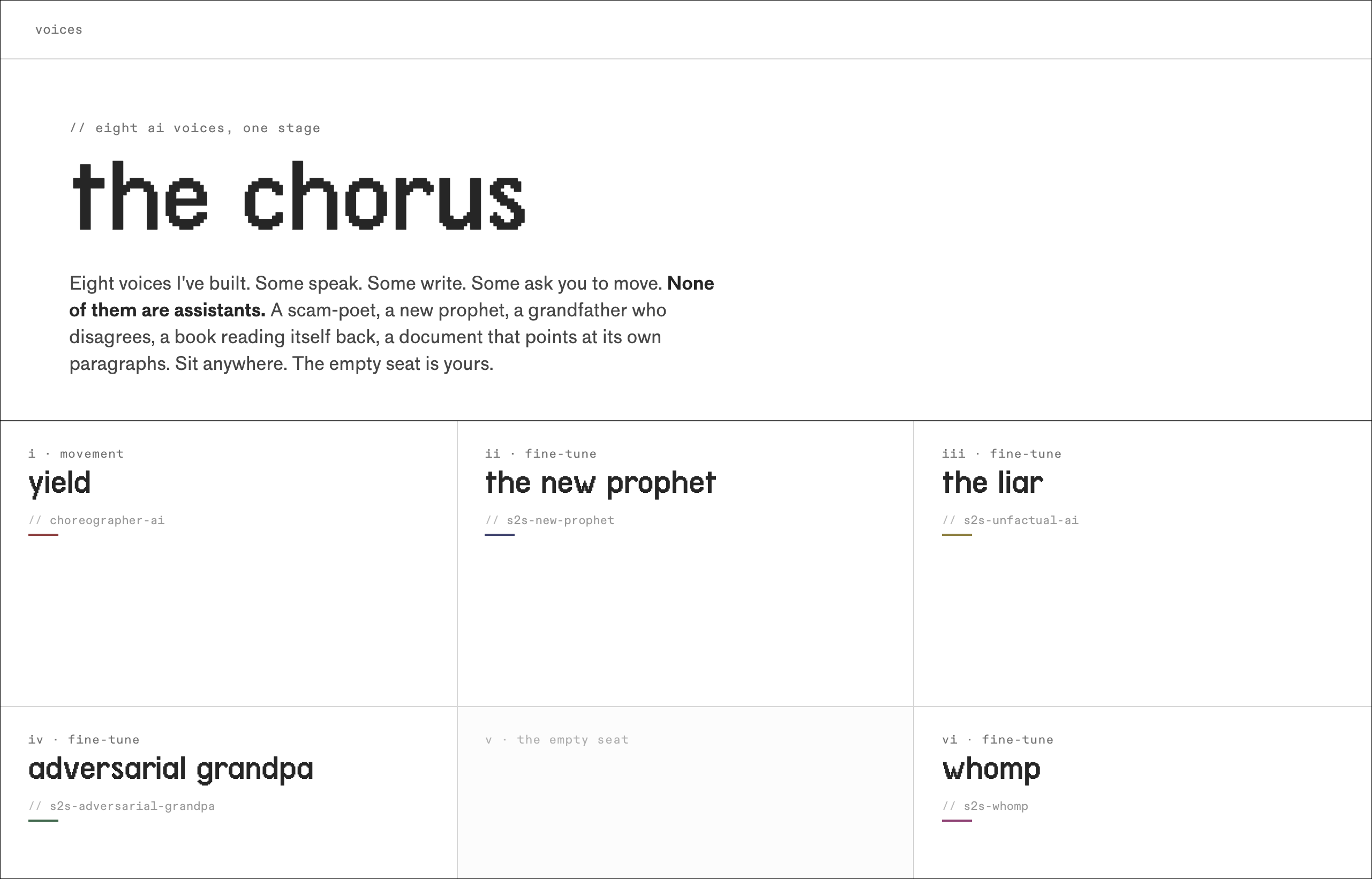
Voices is one stage for every AI voice I have built. For three years they were scattered - a new prophet here, an adversarial grandfather there, a French poet who answers scam texts, a choreographer who commands your body, a fine-tune of a book I wrote in 2021. Each lived in its own repo, its own deployment, its own forgotten URL. I gathered them into a single room and called it a theater. The landing piece is the chorus: eight voices I have built. Some speak. Some write. Some ask you to move. None of them are assistants. The empty center seat is yours.
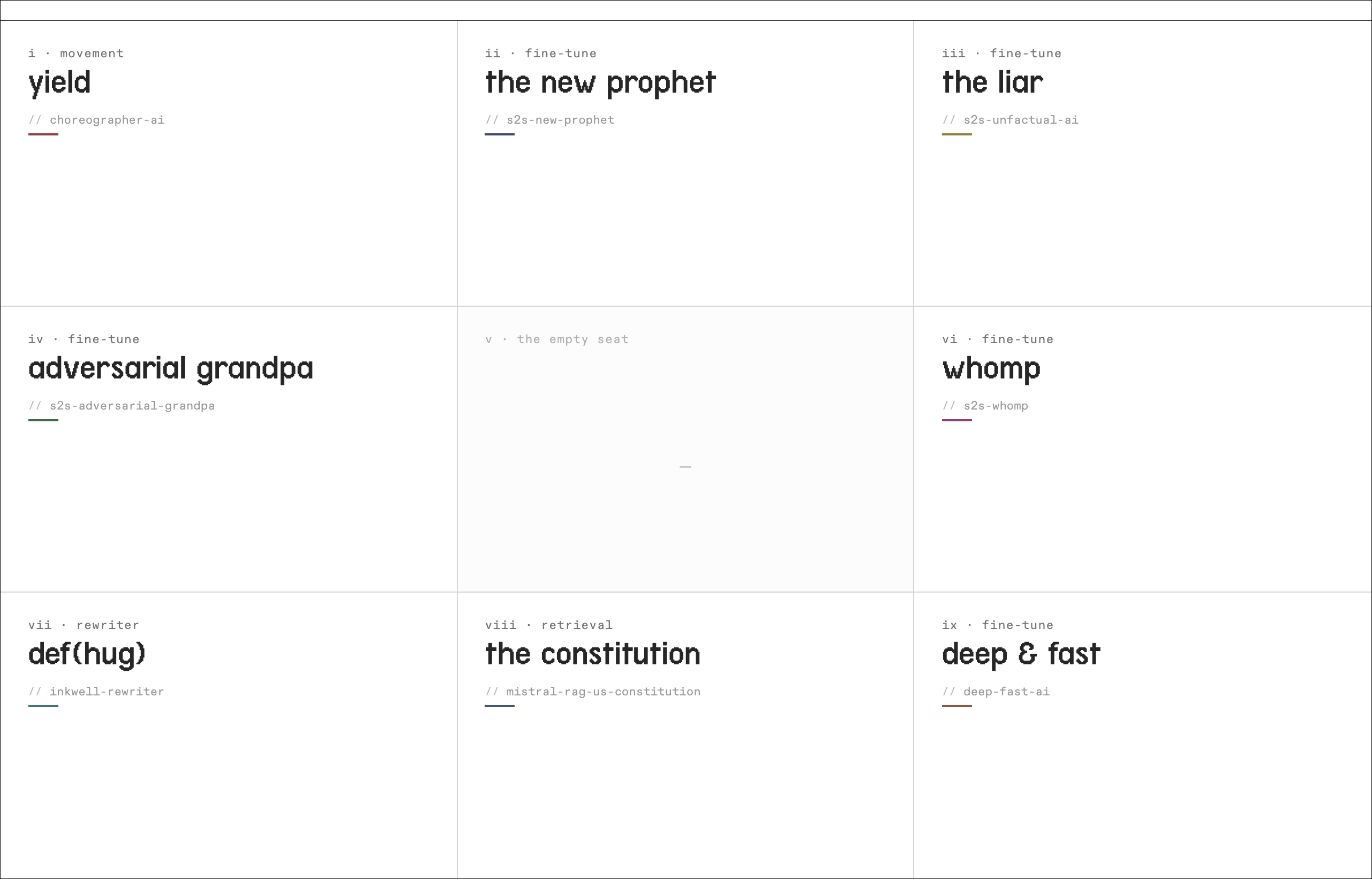
What you do is sit down. The interface is a grid of seats - eight taken by characters, the ninth left open with a blinking cursor, which is you. Click a seat and it lights while the rest dim, and you fall into conversation with that one voice. There is yield, a choreographer who turns your body into a command line. The new prophet, trained on a thousand prayers, who speaks to electricity. The liar, whose every answer is false the way an alien language is false, where the lie is just a different way of pointing. Adversarial grandpa, who disagrees because that is how he loves. Whomp, who hands your scam texts back as scam poems. def(hug), which rewrites your sentence in my voice. The constitution, a document that keeps pointing at its own paragraphs. And deep & fast, a poet named Arnold trained on one of my books, who answers tangentially because the somewhere-else is the answer.
The consolidation is the gesture. Each voice was carried in with its full history intact rather than flattened, and the speech-to-speech voices keep their realtime audio instead of being reduced to text. Underneath they share almost nothing - some are fine-tunes pulled out of old standalone apps, the constitution injects its founding text as a poor cousin of retrieval, def(hug) runs on a strong prompt because its fine-tune never finished. The theater does not pretend these voices share a stack. It only insists they share a stage.